
Sourcing
How to Compare Wholesale Suppliers: A Step-by-Step Framework
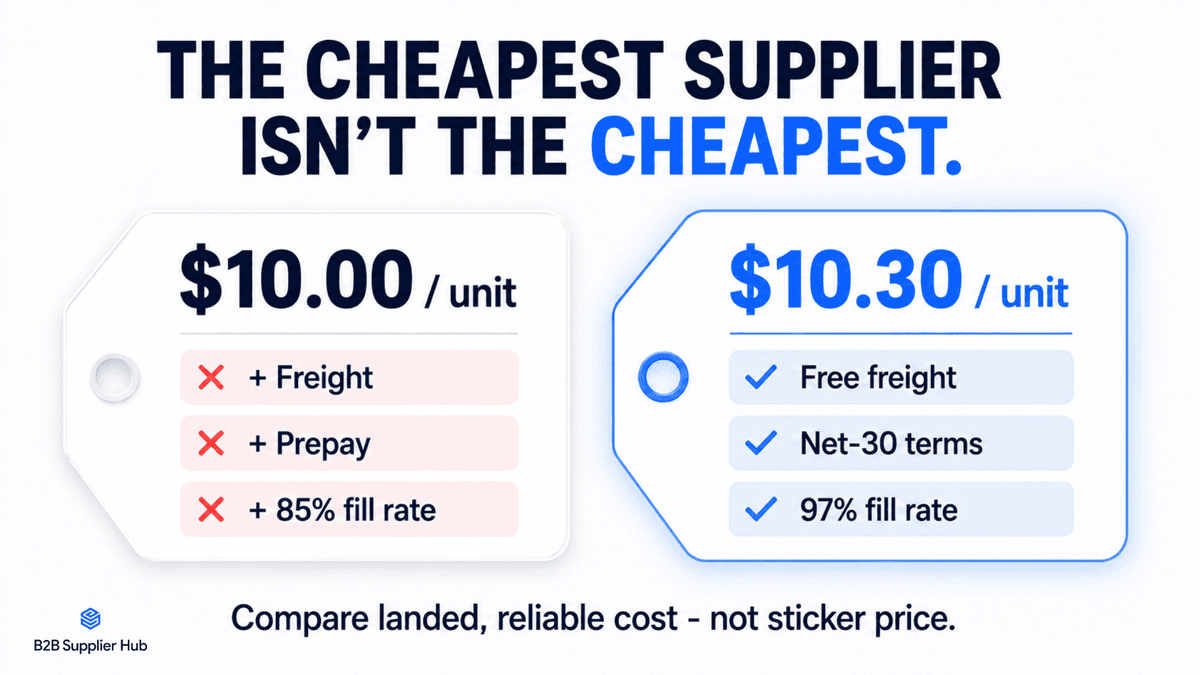
Most wholesale sellers compare suppliers on one number: unit cost. It feels rigorous. You got three quotes, you picked the lowest. But unit cost is the most misleading single number in wholesale, and choosing on cost alone is how sellers end up married to a distributor who ships late, shorts orders, and produces invoices Amazon won't accept.
This is the framework we use to compare suppliers properly. It works whether you're choosing between two distributors for a new SKU or auditing whether your current supplier still deserves the business.
Why Comparing Wholesale Suppliers on Price Alone Always Fails Amazon Sellers
A supplier who is 3% cheaper but takes four weeks to ship and fills 60% of your order lines is not cheaper. Here's what that "discount" actually costs you:
- Stockout days. Every day your listing sits out of stock, you lose sales and Best Seller Rank. Recovering rank costs more than the 3% you saved.
- Capital locked in transit. A four-week lead time versus five days means your cash is tied up nearly a month longer per turn.
- Shorted orders. If you planned Q4 inventory around 500 units and received 300, the per-unit price is irrelevant — you're now emergency-sourcing at worse terms.
- Rejected invoices. An invoice Amazon won't accept for ungating or an authenticity complaint can cost you the ASIN entirely.
The number that matter is landed, reliable cost: what a unit actually costs you, delivered on time, in full, with paperwork that protects your account.
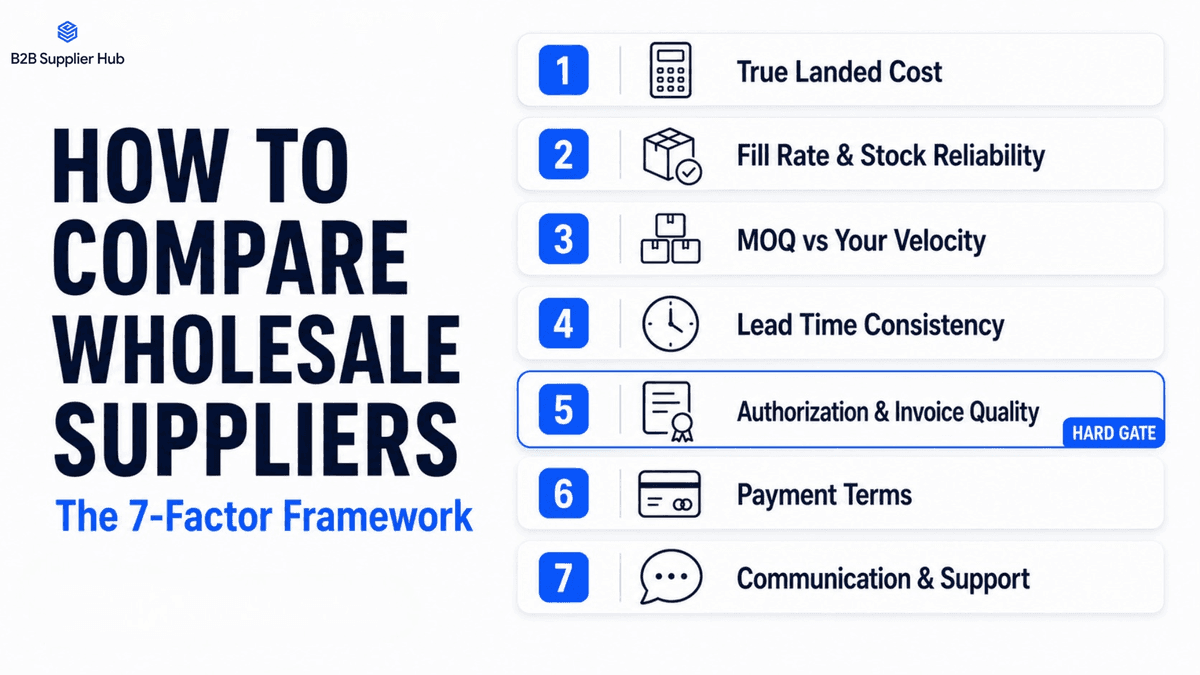
The 7-Factor Wholesale Supplier Comparison Framework for Amazon Sellers
Compare every supplier on these seven factors, in this order of priority.
Factor 1: True Landed Cost (Not Just the Unit Price)
Unit cost + freight + prep + the cash-flow value of payment terms. A supplier at $10.20/unit with free freight and net-30 usually beats one at $10.00/unit with $0.35/unit freight and prepay. Calculate landed cost per unit before comparing anything else.
Factor 2: Stock Reliability and Fill Rate Consistency
Fill rate is the percentage of what you ordered that actually ships. Industry guidance generally treats 92–98% as a healthy fill rate, and B2B distributors often run lower than e-commerce fulfillment operations. A distributor consistently shipping 85% of your order lines is quietly taxing every PO you place. Ask new suppliers directly: "What's your typical fill rate on orders like mine?" Then track it yourself from your first three orders. The real number beats the claimed one.
Factor 3: Minimum Order Quantity Relative to Your Sales Velocity
A great price at 500-unit minimums is a bad price if you sell 40 units a month. That's 12+ months of inventory: capital locked up, storage fees accruing, and full exposure if the listing saturates. Compare MOQ against your monthly velocity. Anything beyond 2–3 months of stock needs a strong justification.
Factor 4: Lead Time Consistency and What Delays Actually Cost You
A supplier who always ships in 7 days is easier to run than one who ships in 3 days sometimes and 21 days other times. Consistency lets you cut safety stock and reorder with confidence. Ask for typical lead time and worst-case lead time and note the gap.
Factor 5: Authorization Status and Whether the Invoice Will Pass Amazon Review
This factor can veto everything else. If the distributor isn't authorized for the brand, their low price may come with gray-market risk, IP complaints, and invoices that fail Amazon's review. Amazon's requirements are specific: invoices must come from authorized distributors or manufacturers, include full supplier contact details Amazon can verify, and match your seller account name and address retail receipts don't qualify. Some brands convey resale rights only through specific distributors, so sourcing from a legitimate-looking supplier does not guarantee authorization. Before your first order, confirm: Is this distributor authorized for this brand? Will their invoice pass Amazon scrutiny? (Full detail in our guides on authorized distributors vs. middlemen and getting approved by distributors
Factor 6: Payment Terms and How They Affect Your Cash Flow
Net-30 is effective margin. If your inventory turns in under 30 days, net terms mean the supplier is financing your inventory, you sell the goods before paying for them. A 1–2% price premium for net-30 is often worth paying, especially for fast-turning SKUs. Prepay suppliers should be meaningfully cheaper to compensate.
Factor 7: Communication Quality and Responsiveness of Account Support
The soft factor that predicts everything else. A rep who answers in hours, flags price changes before they hit, and warns you about upcoming stockouts is operationally worth real money. A supplier you have to chase for a price list will be a supplier you have to chase for everything.
How to Score and Rank Wholesale Suppliers Using the 7-Factor Framework
Turn the seven factors into a weighted scorecard:
- Score each supplier 1–5 on every factor.
- Weight by your business stage:
- Under ~$1.5M revenue: weight landed cost and MOQ heaviest capital is your constraint.
- $1.5M–$10M: weight fill rate, lead time consistency, and authorization heaviest reliability is your constraint, and one account issue hurts more than a 2% cost difference.
- $10M+: weight terms and account support heaviest, you're optimizing working capital and team efficiency at scale.
- Multiply, total, compare.
Authorization is scored like the others but acts as a hard gate: a supplier who fails it is out regardless of total score.
A Worked Example: Comparing Two Real Wholesale Suppliers Side by Side
Illustrative numbers, same SKU, seller doing ~$3M/year:
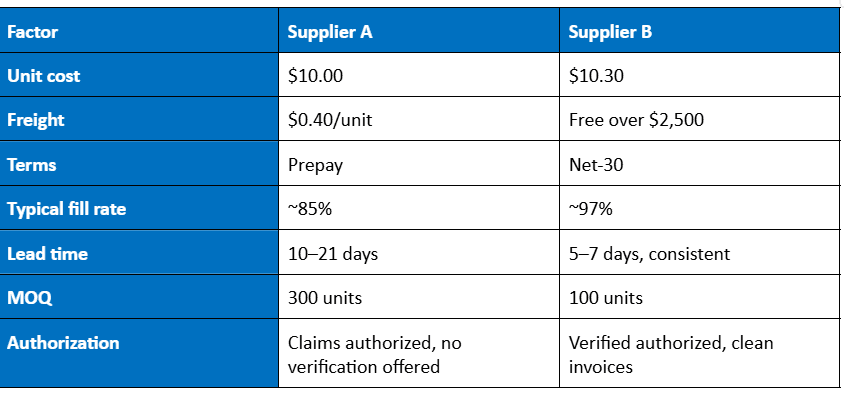
Supplier A wins the only comparison most sellers run sticker price. Supplier B wins everything that determines whether you actually make money: landed cost is nearly identical once freight is included, net-30 finances the inventory, the 97% fill rate protects your listings, and the verified authorization protects your account. On a mid-stage weighted scorecard, B wins decisively.
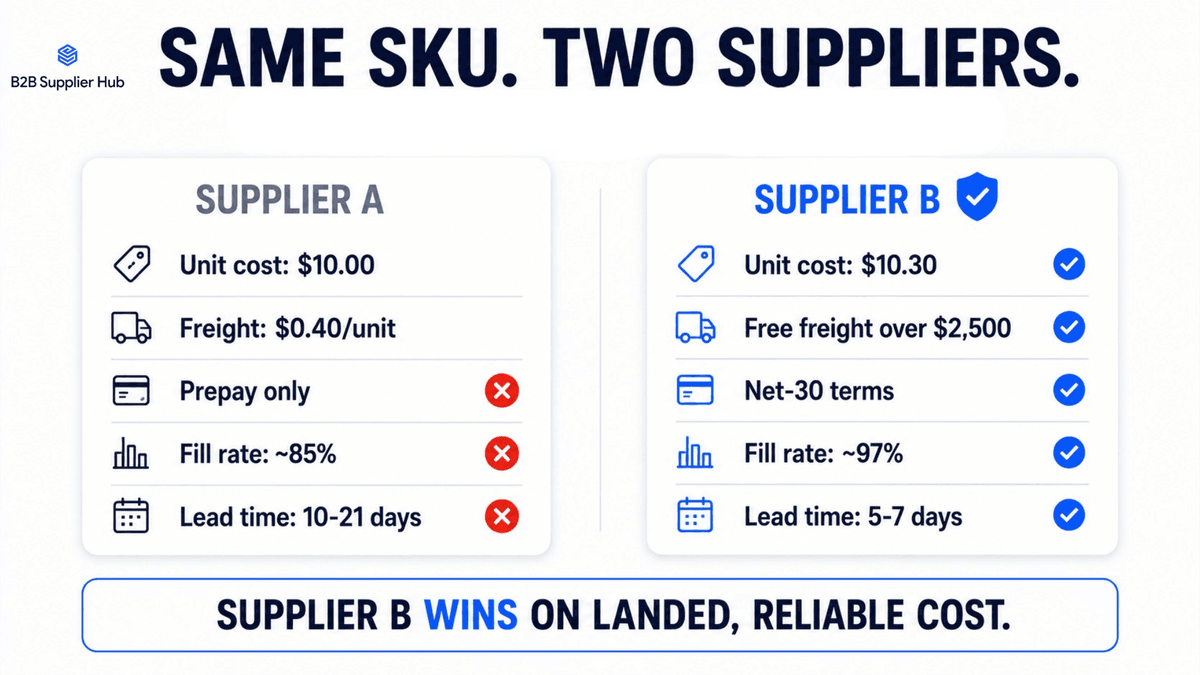
This side-by-side view, every supplier carrying a product, with cost, stock, MOQ, ETA, and authorization requirements on one page is exactly the comparison B2B Supplier Hub is built to make instant instead of a week of emails.
When It Makes Sense to Keep Two Wholesale Suppliers for the Same Product
Comparison doesn't always mean elimination. If two suppliers both clear your bar, keep both: primary for volume and terms, secondary kept warm with occasional orders as insurance against stockouts and price increases. Single-supplier dependency is one of the most common ways wholesale businesses get hurt. We cover it in depth in Why Single-Supplier Dependency Kills Wholesale Businesses.
The bigger shift is this: stop treating price as the comparison and start treating it as one input out of seven. The sellers who score suppliers on landed cost, reliability, and paperwork make fewer emergency reorders, lose fewer listings, and keep more of the margin they planned for. Run every new supplier through the scorecard before the first PO. Ten minutes of scoring beats months of living with the wrong choice.
Frequently asked questions
01Is the cheapest wholesale supplier always the best choice?
02How do I compare wholesale prices between distributors?
03What should I ask a distributor before choosing them?
04How many suppliers should I have for one product?
05Does a low price from an unauthorized distributor matter?
The B2B SupplierHub Team
Wholesale & sourcing
Stop hunting suppliers by hand. Type a UPC instead.
B2B Supplier Hub shows the suppliers in our network carrying a product on one page: wholesale cost, stock, and retail price side by side. Free to search, no card required.